I was lucky enough to have two recording sessions with live musicians this month. The first was a film score – a 15-piece string orchestra and piano, remotely recorded with FAME’s Orchestra in North Macedonia for a short film. The second was a passion project of sorts; a commission by a close friend and long time collaborator, recorded at my alma mater, with an old professor and the person who taught me to play the cello. These projects differed in so many ways, and I have so many thoughts now that I am out the other side. I’m going to share these here, both to unpack my own mind and also so that others might not repeat my mistakes.
Takeaways (or TL;DR)
I want to begin by sharing my biggest-picture thoughts. These were shared between both sessions, and I think they are good to have in mind whenever entering a session as the composer.
- Be certain and straightforward with your feedback.
- Know what you’re listening for.
- Stop thinking (so much, and about what others think).
I will explain more about what I mean by these as we go through my recounting of each session, but in short – as the composer, your job is to communicate. You have a vision for the music, and you are the only one who really knows what the end result needs to be. You can’t be wishy-washy. State what you want and make sure your players understand. If you’re going to have them do another take, communicate what it is you’re trying to accomplish with it. In order to know what it is you need to say, you need to know what it is you’re listening for. As we’ll explore later, this is nebulous, and different for each piece, but it can be simple things like tempo, as well as more complex ideas like phrasing and balance. Finally, you need to remember that at the end of the day, you and your players are in the session to do a job and accomplish a goal. You cannot afford to let concerns like whether people are bored, or getting tired, or would rather be somewhere else, keep you all from accomplishing that goal. If it means playing a section over and over, so be it. Focus more on the intent, and less on other humans’ perception of you.
Session 1: North Macedonia
The first session was a surprise project: a rush job, where I was brought on by another composer to get music ready for an orchestra session less than a week away. To quote this other composer, this was a bit like jumping onto a burning train. Quality collaborators and experienced professionals, but we were out of time and behind schedule. Typical protocol was thrown out the window, which included working without a contract (something I will never do again, but that’s a topic for a different post), and communication with the director was minimal, so I was basically left alone to write cues. The goal was simple: get the job done, so we can submit to Cannes.
There are many things necessary for a successful orchestra session: sheet music is an obvious one, but this means the conductor’s score as well as individual parts for the musicians. The world of film music also has many specific standards for sheet music – large time signatures, measure numbers every bar, certain sizes of paper and a certain layout of information, and it all needs to be clear, concise and detailed. Simply getting this all together is often one person’s entire job, but on top of this, I had to compose one-and-a-half of these cues essentially from scratch, after just learning about this project’s existence several days before. Good thing I love crunch time.
There’s a certain mindset that comes about when you don’t have the time to overthink. Normally, writing music for me is akin to wringing out a dishrag of my own emotions, ideas and ego. I write, I’m unsatisfied with the result, I erase it, I try again, over and over and over, and all through this I’m wondering if I really have any idea what I’m doing, and whether I should’ve just gotten a business degree. When it’s crunch time, though, that process has to be truncated. Don’t get me wrong, there’s still plenty of emotional-dishrag-wringing, but there simply isn’t time for worrying about things like personal ability, career potential, and all the other things that get wrapped up in trying to create something. So when a project like this requires working into the early morning day after day, I find that I love it. The music that comes out is good, because I set my bullshit aside, and I get the work done.
(disclaimer here: crunch time is only fun for so long, and burnout is real. Stories like Mick Gordon sleeping under his desk for months at a time on Doom: Eternal are very different than burning the midnight oil for a week. Take care of yourself, please.)
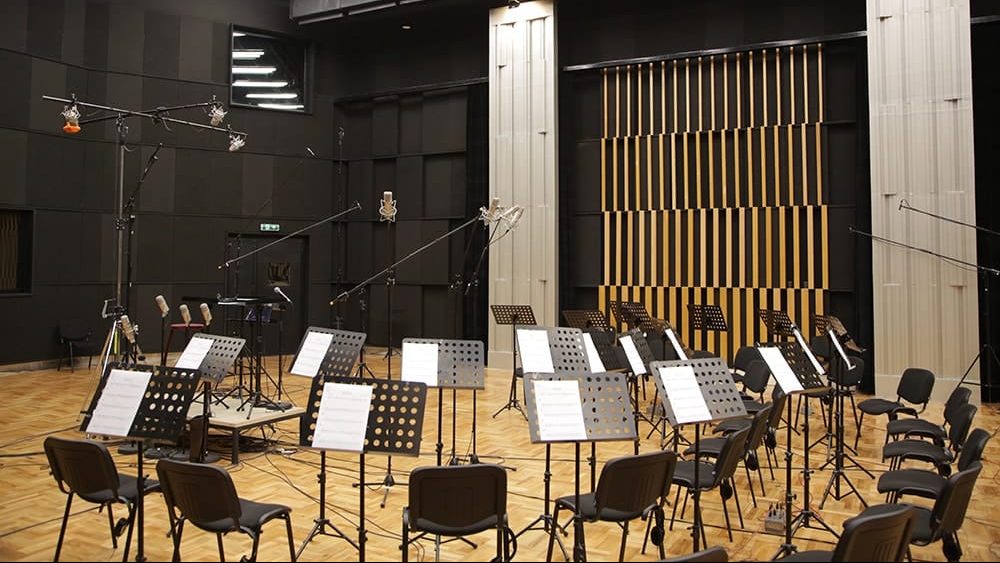
Now that I’ve finished rambling about crunch time, let’s jump ahead a bit. The music is written, the sheet music is formatted, the MIDI mockup sounds decent, the ProTools session is built (shoutout DJ, who put that together for my Avid-averse self. I still owe you lunch), and all that’s left is to actually get a good recording. This production truly spanned the globe – composers in LA, director and producer in Puerto Rico, and the orchestra in North Macedonia – so the session took place at 9:30 am LA time, 6:30 pm for the orchestra. I was still drinking my coffee, and the musicians were thinking about dinner.
These remote sessions are fascinating in that they are so utilitarian, and not in a bad way. If your sheet music is detailed enough and your ProTools session is set up right (don’t worry DJ, it was perfect), there are almost no questions to answer beforehand. I was asked which cue to start with, and we were off. We had one hour of recording time, and roughly 4 minutes of music to get recorded. These remote-session orchestras are so used to this type of thing that it was almost shockingly easy to get everything done. They would do a take, they would ask for a bit of feedback, they would do a second take, and nine times out of ten that second take would be perfect. I was endlessly grateful for the conductor, who knew exactly how to structure the session – where to begin and end, what could just be a partial take rather than a full run, what elements of timing and phrasing on which we needed to make sure we were on the same page. We had no trouble whatsoever getting everything done in time, and we even sent the strings home a bit early. However, this is where I realized just how much I have yet to learn.
As I mentioned, between each take there would essentially be a pause for feedback, and I was expected to be the one to give it. This presented an issue for me – they had played the music “correctly,” so what am I supposed to say? I’m almost embarrassed to admit this, but I had almost no idea what I was supposed to be listening for. As far as I was concerned, it sounded fantastic, just by virtue of not being MIDI anymore! While I think that this is simply something that will come with time and experience, I also think it would have been better if I had entered the session with some sort of intention. I wish I had a more conclusive way to end this section, but the truth is I’m still not sure. At the end of the day, if it sounds good, am I supposed to say anything at all?

Session 2: Colorado
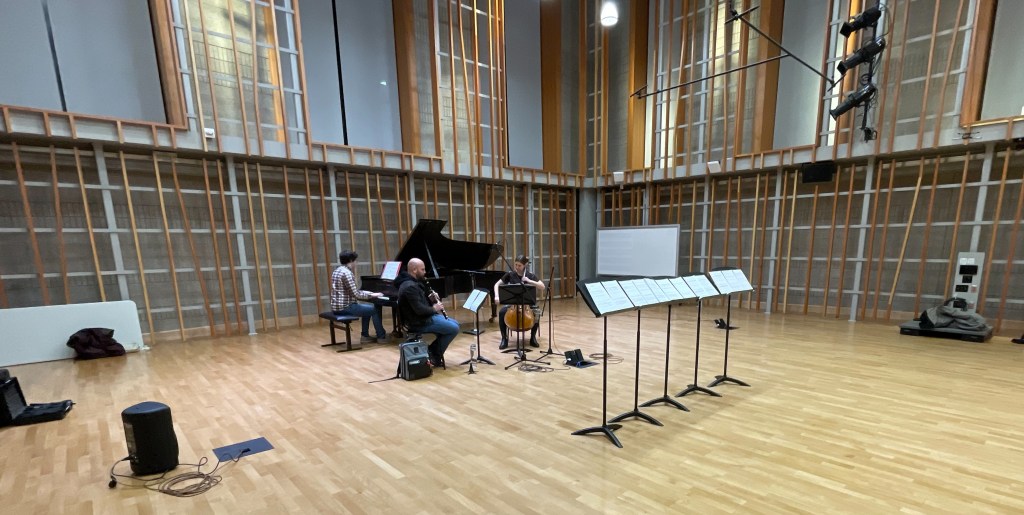
The second session was the payoff of a project that had been in the works for months. Way back in early 2024, a dear friend of mine had approached me about writing a piece of music for him, so that he could use it as background for his sleight-of-hand magic routine. He had already been performing to a Jerry Goldsmith piece, so we had things like tempo and structure laid out for us already. We chose piano, cello, and clarinet for the ensemble, and from there the music flowed easily for me. It was an incredibly rewarding project, one that let me explore many musical ideas I had been knocking around, as well as pushing me to explore new frontiers. In addition, the two of us have collaborated on many musical projects before, having been in a band together for years, so communication was natural, and I was very grateful for his feedback on the in-progress work. It resulted in a piece of music I feel quite proud of, and an experience I’m very grateful for.
We set up a time to record at our alma mater, the University of Colorado Boulder, with the help of an old teacher. Having just moved away from Colorado a mere 6 months ago, the trip had the added benefit of getting to visit a place and people I love deeply. This session was quite different from the remote session I described earlier; rather than a pre-formed ensemble, we built our little chamber group through various connections and recommendations. I had recorded with the cellist before (she’s my first call in Colorado for sure), but I was meeting the clarinetist and pianist for the first time at that session.
There are three lessons I want to learn from this session:
- Build rapport with your musicians, so that you know each other as humans in addition to professionals.
- Be clear and concise with your feedback.
- Know what you’re listening for, and be sure you get it.
Here is the first learning moment for me of this session: building rapport is vital. At the end of the day, all of us in that room were musicians, but I didn’t know them as humans, and they didn’t know me either. I think it would have been a very valuable use of time just to talk a bit, get to know people, and – perhaps most importantly – fill them in on what exactly our goals were with the piece. Instead, I basically just greeted them, shook hands, and said “ok go warm up and then we’ll get started!” It wasn’t until about halfway through the session that I had really informed them we were there to record music for a magic routine! In addition, I think we also wasted some mental energy evaluating each other mid-session – is this person overly critical, or easygoing? Are they happy to be here, or do they have things they’d rather do on Friday night? Are they experienced or new to recording? I think in general, the session would have flowed more easily if we had spent a little time just getting to know each other, and there would have been far less anxiety for me personally.
That said, the session still went very smoothly. We had three hours reserved to rehearse and record, and we were out in two. Without a conductor, it was essentially up to me to run this session, and I do think that this is where my inexperience shows a bit. I had a few sections I wanted to talk through, but once we got into full takes, I found that sometimes I had nothing to say for feedback once again! This was another big learning moment for me: as the composer, you really need to be clear, straightforward, and certain with your feedback. For example (and this ties in to building rapport too): the topic of purpose for this piece only came up at a certain point. It begins with a piano intro, and the pianist was being just a smidge too free with his tempo during this. Instead of being direct with my feedback (e.g. “Hey, this tempo needs to fluctuate less, as it’s being used as background for live performance”), I basically word-vomited a bunch of stuff about tempo, and ended up needing to explain the magic-act part of our goals in the midst of the session. I felt a bit foolish, the pianist seemed confused, and it wasted time.
One other example of how I could improve my communication: At one point in the session, we were doing several takes on one section of the piece. We had simply made a couple mistakes in that part, and I wanted to make sure we got it right. However, I didn’t say much about why we were doing that section again, as I figured the player who made that mistake didn’t need it pointed out. However, one of the players got my attention and asked “hey, what do you need from us for this section? Could you explain what you need us to do differently?” I realized in that moment that from their perspective, they were just playing the same thing over and over again, and not being told why! They were looking to me for direction, for me to communicate my vision, and I wasn’t letting them in on my thoughts. Going forward, it is a goal of mine to have a purpose for each take – something to focus on, or a reason for their work.
On a similar note, I made one relatively-major mistake in this session: I didn’t pay enough attention to tempo. I didn’t use a metronome to check time, and when I listen to the recording now, I realize that we simply played it too slow. This all ties back to knowing what to listen for, and especially for something meant to be performed to, it is a fairly critical error. It’s not so far off that it will affect the success of the piece, but it is something I will notice when I listen to it. In a future post, I may try developing a checklist of sorts of what to listen for mid-session. When not recording to a click track, tempo is certainly an important one.
I also think that this all ties back into making sure you don’t overthink. We started this session at 6:30 pm on a Friday evening, and I wanted to be considerate of the players’ time. However, we ended with an hour extra, and on top of that, these are professionals! If I had worried less about getting people out early, I would have been more focused on getting the piece right, and I doubt I would have missed something so simple as a too-slow tempo. We probably still would’ve been out early!
Conclusion
If you’re still here, thanks for reading. I’m a very stream-of-consciousness type of guy, and I don’t do much planning ahead of time for these. That said, I hope it’s helpful in some way, even if it’s just to laugh at my foolishness. As thanks for getting through the whole thing, find a link here to a secret SoundCloud playlist, where you can hear the tracks I’ve talked about today (but don’t share them yet, please).
At the end of the day, both of these sessions were immensely successful. We made some beautiful music that didn’t exist before, and I feel incredibly fulfilled by the endeavor. I can only hope to learn so much on every project I do.
Isn’t music the best?
 Christopher Kerr
Leave a comment